How to draw a positioning map with your own customers
Two axes, a handful of competitors and one honest dot for yourself (sample note).
Taking new positioning projects from November (sample)
Open Ground Strategy (sample) is a marketing strategy consultancy for growing companies. We map where customers place you and your competitors, choose the position you can own, and plan the campaigns that move you there.
Four senior strategists, no juniors on your account. Projects from six weeks (sample).
Made slowly, by hand
Quick and handy
Everyday price
Special-occasion price
Sourdough micro-bakeries
Patisseries
Farmers’ markets
Coffee-chain pastries
Supermarket bakery aisle
Station kiosks
Our client before
Where they could stand
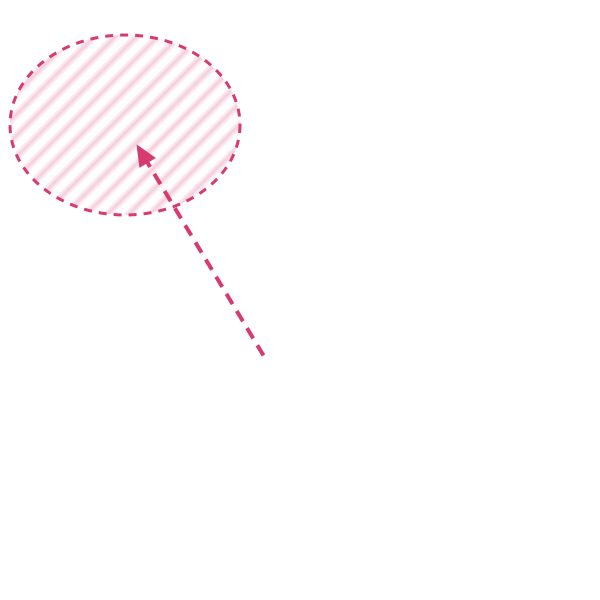
How to read it: each olive dot is a competitor, placed where 420 surveyed customers put it. The ring is our bakery client before the project, the raspberry dot the position we chose together, the hatched oval the ground nobody held (sample).
Most companies drift there without deciding to. These are the four things owners tell us in the first call.
When nothing else separates you, the cheapest offer wins the argument and your margin pays for it.
Swap the logo and nobody would notice. That is a positioning problem, not a design one.
Without an agreed position, each brief reinvents what the company stands for, and each agency guesses.
Somebody else is winning the new customers, usually with a clearer promise than yours.
Each piece of work ends with something your team can use on Monday: a map, a written position, a plan or a quarterly report.
Customer interviews, a survey and a competitor audit, turned into a positioning map, one positioning statement and the message rules your team and agencies write from.
For a launch, a new market or a relaunch: who to reach first, through which channels, with what message and budget, month by month for the first six months.
A short customer survey every quarter that re-plots your position on the same map, so you see whether the move is working before the year is out.
Example prices.
Three projects, each on its own map. The ring is where customers placed the client before; the raspberry dot is where they placed them a year later.
By hand
Quick
Everyday
Special
Before
After
From one more bakery to the early, handmade bakery at everyday prices. Opening at 6:30 became the headline.
Springfield, 2024 (sample)
For racers
For commuters
Sells bikes
Keeps you riding
Before
After
From selling racing bikes against online stores to keeping commuters riding: same-day repairs and a service plan.
Two shops, 2023 (sample)
Sold on saved hours
Sold on features
For any business
For one trade
Before
After
From a feature list for any business to the hours it saves one trade: dental practices.
40 staff, 2025 (sample)
Four steps in this order. Most projects take six to eight weeks to the plan; tracking runs on after that.
1
Weeks 1 to 3
Twelve customer interviews, a survey of 300 to 500 buyers and an audit of up to eight competitors.
2
Week 4
A one-day workshop with your leadership team. The map goes on the wall and we pick one position together.
3
Weeks 5 and 6
The positioning statement, message rules and the first campaigns, channels and budget.
4
Every quarter
The same short survey, re-plotted on the same map, with a one-page report.
One day, your leadership team and the map on the wall. By five o’clock you have chosen one position and agreed what you will stop saying.
Strategy call, 30 minutes
Free
Positioning project
6 to 8 weeks: research, workshop, statement and message rules
From $18,000
Positioning workshop on its own
One day, with your own research
$4,500
Go-to-market plan
4 to 6 weeks
From $14,000
Brand tracking
Per quarter, survey of 300 customers
$2,800
Example prices, before tax.

Two axes, a handful of competitors and one honest dot for yourself (sample note).

Standing for a little of everything avoids arguments inside the company and loses them outside it (sample note).

If you cannot answer these, the agency will answer them for you (sample note).

Tell us what is stuck. We will say plainly whether positioning is the problem, and if it is not, who could help. The call is free (sample).
Demo photos from Pexels by Jakub Zerdzicki, Pavel Danilyuk, Alena Darmel, Sora Shimazaki, James Collington, Speak Media Uganda, Annushka Ahuja, https://kaboompics.com/, Tima Miroshnichenko, RDNE Stock project. The theme download contains placeholder pictures, not these photos.